
The talk series brought together students, craftspeople, designers, researchers, and members of the wider public to engage with Palestinian traditional crafts and the realities shaping their continuity today. Across the sessions, participants explored the histories, techniques, and cultural significance of individual crafts, while also considering the challenges to their survival and the potential for new forms of exchange and collaboration between artisans, designers, and other practitioners.
GLASSBLOWING LECTURE
Artisan: Mohammad Twam (Abu Marwan)
Location: Birzeit University
Participants: 39 students
As part of the Product and Furniture Design course, students participated in three dedicated sessions with Jabaa-based glass artisan Abu Marwan. The sessions included live demonstrations of traditional glassblowing techniques, tool handling, and material behaviour, followed by collaborative experimentation. Under his guidance, students gained direct, hands-on experience with molten glass and developed an appreciation for the precision, discipline, and technical knowledge required in glassblowing.
Building on this experience, students were tasked with designing products that reimagined the traditional uses of blown glass and ceramics. Drawing on the cultural significance and heritage of these materials, they explored how traditional techniques and forms could be transformed into innovative, functional objects responding to contemporary needs and contexts.
The course placed particular emphasis on traditional Palestinian materials, artisan collaboration, and material experimentation, while deepening students’ understanding of the historical and cultural significance of glass and pottery. Through this process, students explored how hands-on craft knowledge and traditional materials can inform contemporary design practice and create meaningful connections between heritage, innovation, and design thinking.
LOOM WEAVING LECTURE
Collaborator: Talleh Center
Locations: Birzeit University & Abu Dis
Participants: 80 students
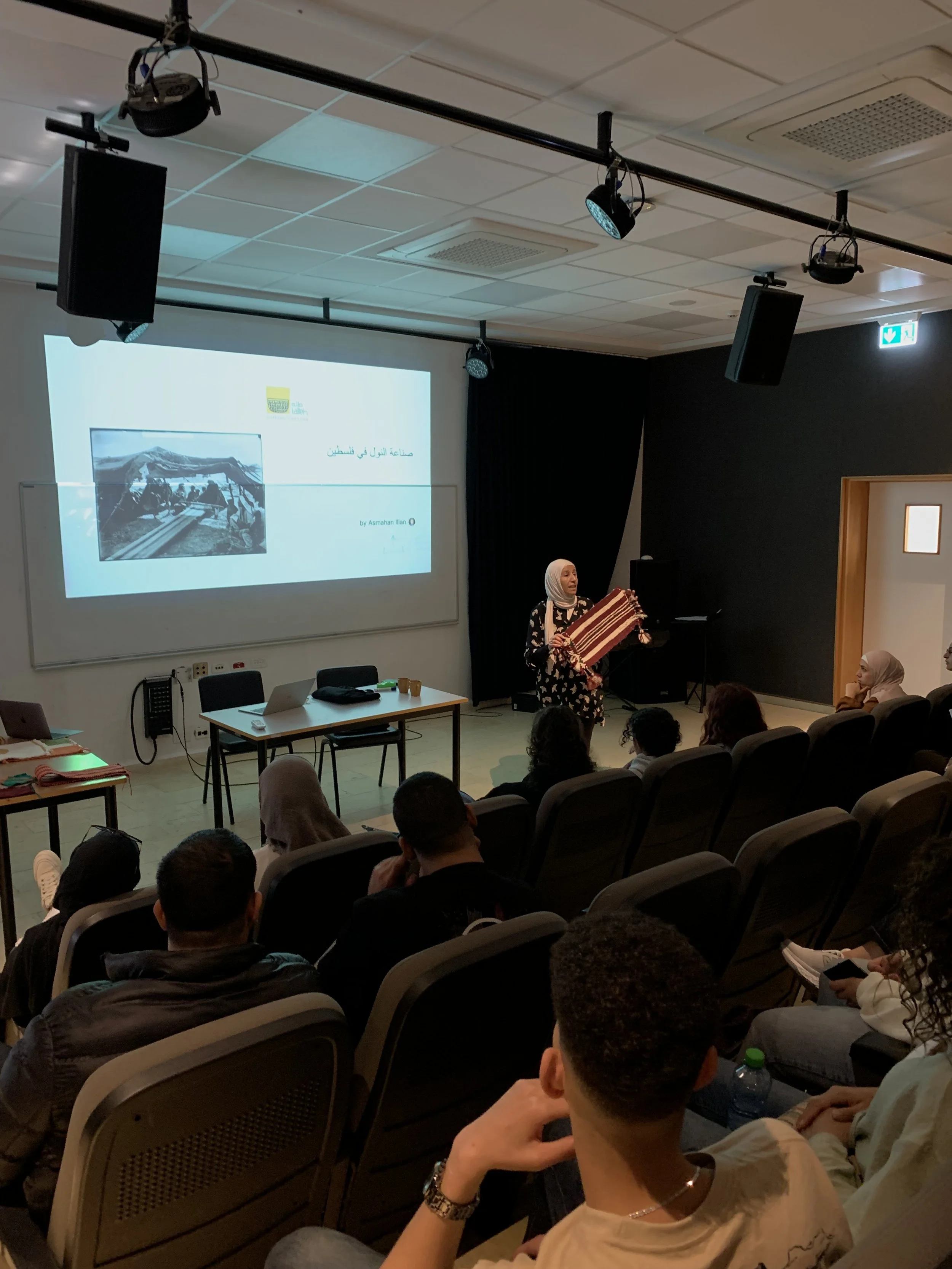
A local female expert led an engaging session on traditional Palestinian loom weaving (noll), introducing students to the craft’s technical foundations, regional diversity, and cultural significance. She began by presenting traditional weaving techniques and the different types of nolls used across Palestine, highlighting their historical and regional specificities.
The session also explored the tools and processes involved in weaving. Through detailed demonstrations, she explained the structure and components of the loom, how a noll is constructed, and the function of each part within the weaving process. She also introduced traditional natural dyeing methods, discussing the use of plants, roots, and minerals as local sources of colour and the sustainable material knowledge embedded in these practices.
Throughout the session, the expert situated loom weaving within Palestine’s changing socio-political context, illustrating how the craft has endured and adapted while serving as a means of cultural expression, identity preservation, and resistance. Physical examples and fabric samples complemented the presentation, allowing students to closely examine the materials, textures, colours, and patterns associated with different Palestinian weaving traditions.
MATERIAL EXPLORATION WORKSHOP
Designers: Areej Ashhab & Raghad Saqfalhait
Location: Qalandia
Participants: 41 students
Course Integrated:
DSIN2340 – Material Properties 2
DSIN2460 – Product and Furniture Design
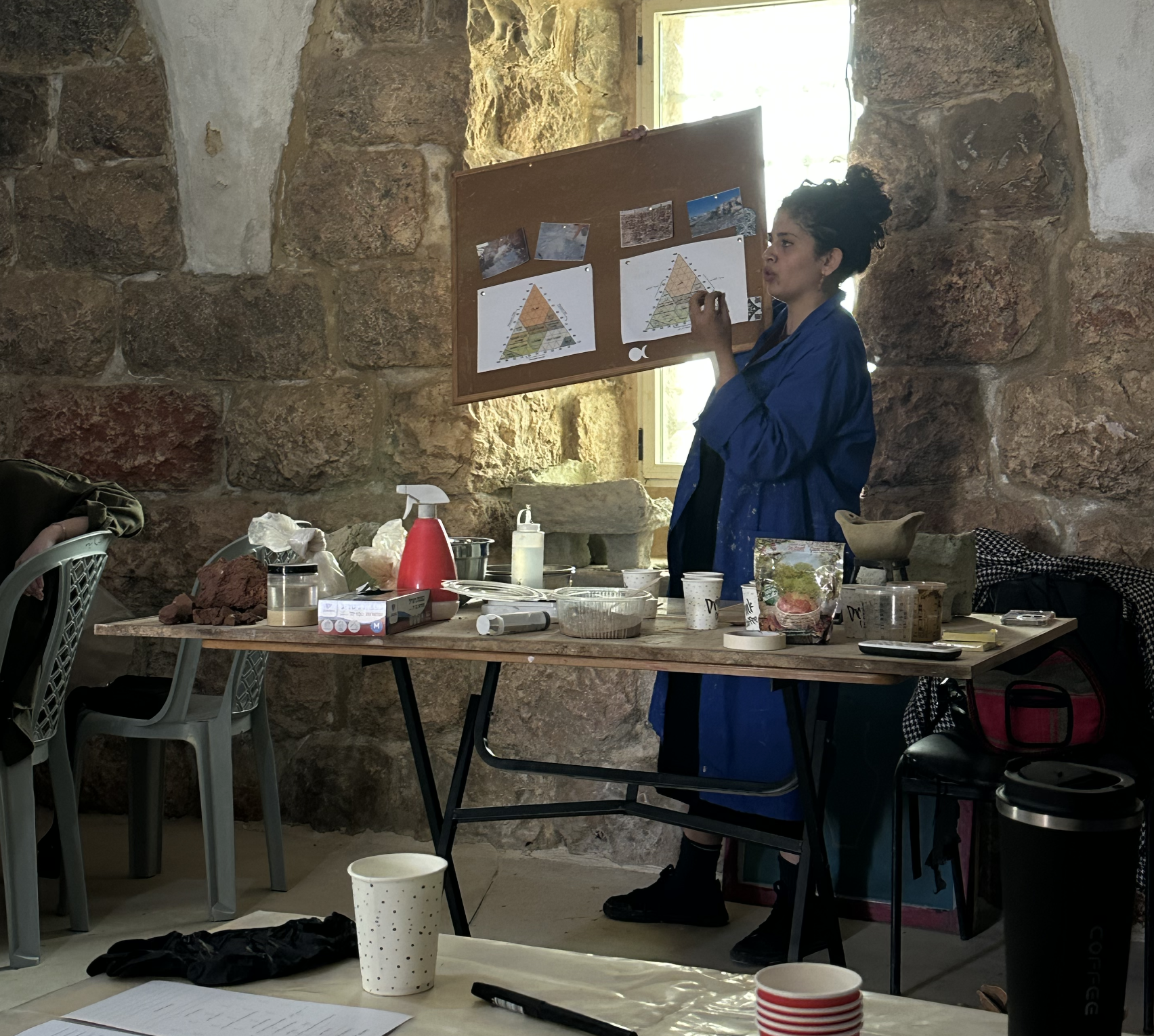
Areej Ashhab facilitated two workshop sessions, while Raghad Saqfalhait delivered a hybrid lecture on their collaborative project. The day concluded with a second workshop session led by Areej. The workshop with Areej took an experimental approach, encouraging students to look beyond traditional pottery-making in Palestine—from the sourcing of clay to its contemporary applications. The lecture by Raghad and Areej focused, in particular, on new types of soil becoming available through construction excavations. Building on this discussion, the workshop introduced students to different types of local soils and invited them to experiment with techniques including hand-moulding, brick-making, and clay printing. The sessions encouraged students to reconsider traditional pottery practices and explore new possibilities for the material and its applications. As a result, students developed a practical understanding of traditional clay techniques, a deeper appreciation for local craft heritage, and greater awareness of clay’s aesthetic and functional properties. The workshops also encouraged them to reflect on how handmade processes, local materials, and inherited knowledge can inform contemporary design thinking and innovation.
MAJDALAWI WEAVING
Speaker: Hossam Zaqout
Location: Online
The talk offered a deeply personal and historically grounded exploration of Majdalawi weaving as both a traditional craft and a powerful symbol of Palestinian cultural identity and resilience.
Hossam began by sharing his personal journey of learning loom weaving from his father and the responsibility he assumed after his father’s passing to preserve and continue the family tradition. He then introduced the technical foundations of the craft, including traditional handlooms, threads and dyeing methods, characteristic patterns, colours, and the production of garments such as the thob. He emphasized that the authenticity of Majdalawi weaving lies not only in its visual language but also in the detailed processes and embodied knowledge passed between generations.
The discussion also addressed the political and economic pressures threatening the craft, including restrictions on raw materials, rising production costs, limited access to threads and dyes, and competition from fast fashion. Hossam explained how these challenges have forced artisans to adapt by using alternative materials, modifying colours and designs, and producing smaller or simplified pieces for contemporary markets.
The talk further highlighted efforts to preserve Palestinian craft heritage, including the Gaza Municipality’s Qaryat al-Funun wal-Hiraf (Village of Arts and Crafts), which provided a space for training and production before being destroyed during the 2021 war on Gaza. Videos documenting the weaving process—from dyeing threads and preparing the loom to weaving and producing traditional thobs—provided an immersive insight into the craft’s technical and cultural dimensions. Ultimately, the talk positioned Majdalawi weaving as more than a craft: it is a vessel of collective memory, identity, and resilience. Its survival depends on documentation, intergenerational transmission, public awareness, and stronger collaboration between artisans, designers, researchers, and educational and cultural institutions.
Designers X Artisans 01: Mother-of-Pearl
Speaker: Issa Kharoufeh & George Al Ama
Location: Wonder Cabinet, Bethlehem
How can an endangered craft remain connected to its heritage while finding new relevance today?
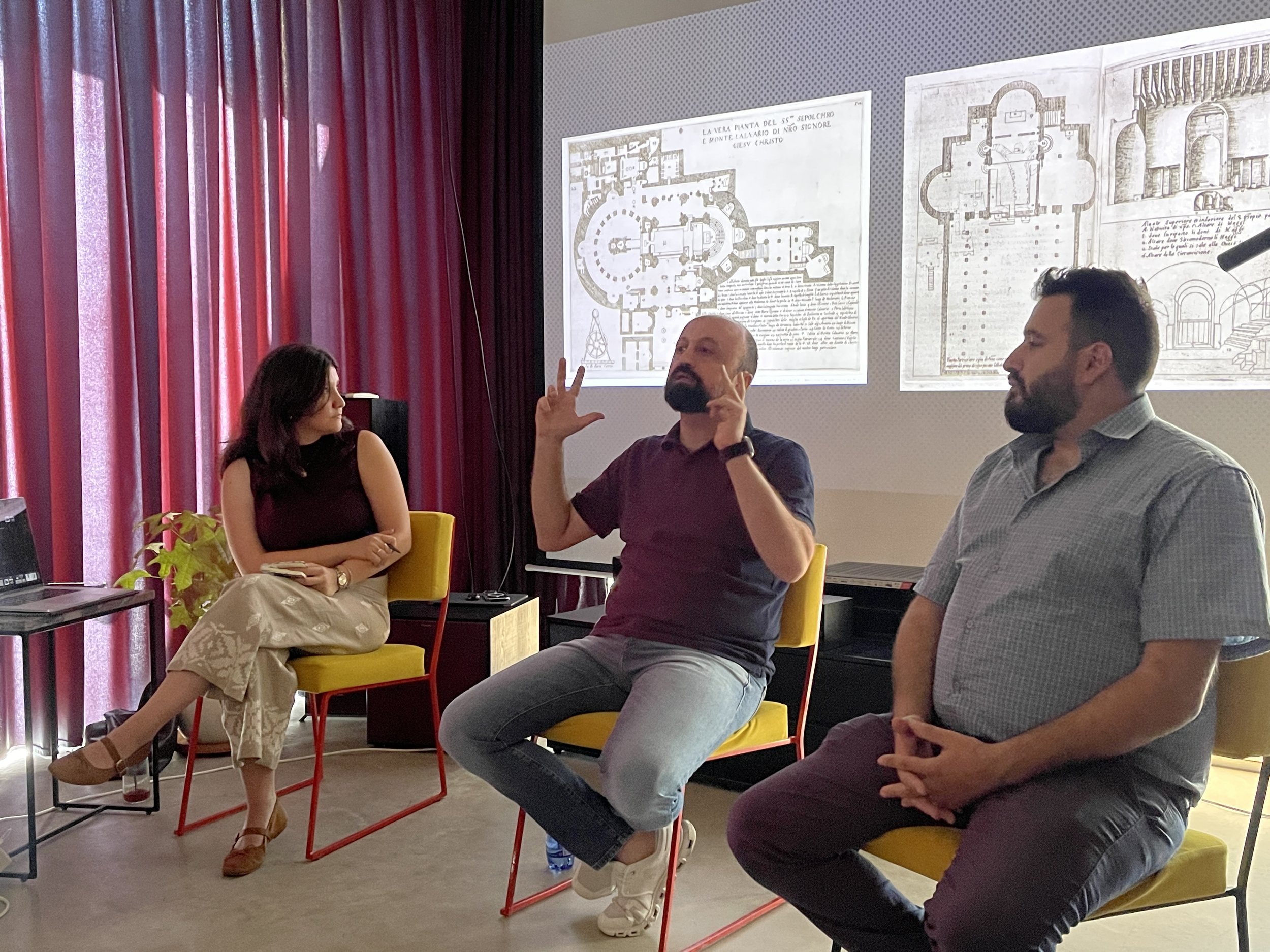
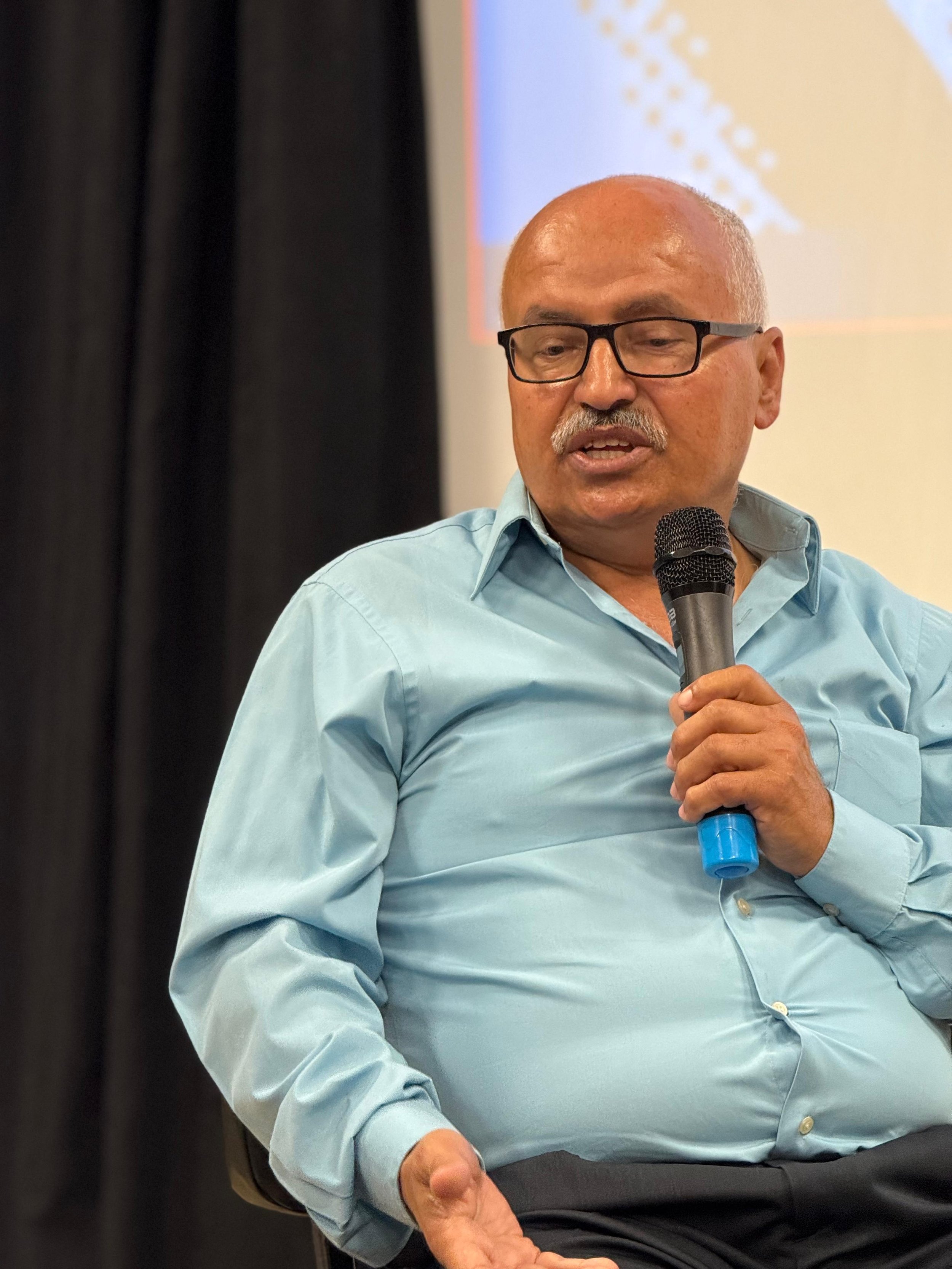
The first public talk explored mother-of-pearl as one of Palestine’s most emblematic yet endangered crafts, tracing its development from its religious export roots and early evolution to the stylistic, economic, and political changes that have shaped its trajectory. Historian and collector George Al Ama explored the craft’s historical development, cultural significance, colonial entanglements, and symbolic value, while master craftsman Issa Kharoufeh, director of the Piccirillo Handicraft Center, discussed its contemporary practice from the perspective of a working artisan and trainer. The conversation examined the technical and aesthetic dimensions of working with mother-of-pearl, as well as community-based models of craft transmission and the challenges of sustaining the tradition today. It also considered the contemporary challenges and limitations of working with mother-of-pearl in Bethlehem and Palestine more broadly, and how designers, students, artisans, and cultural institutions can work together to preserve its heritage while opening pathways for its continued development and contemporary relevance.
Designers x Artisans 02, Talk on Glass Blowing
Speaker: Abu Marwan (Mohammad Twam) and Abu Wahid
Location: Faculty of Art, Music, and Design, Birzeit University
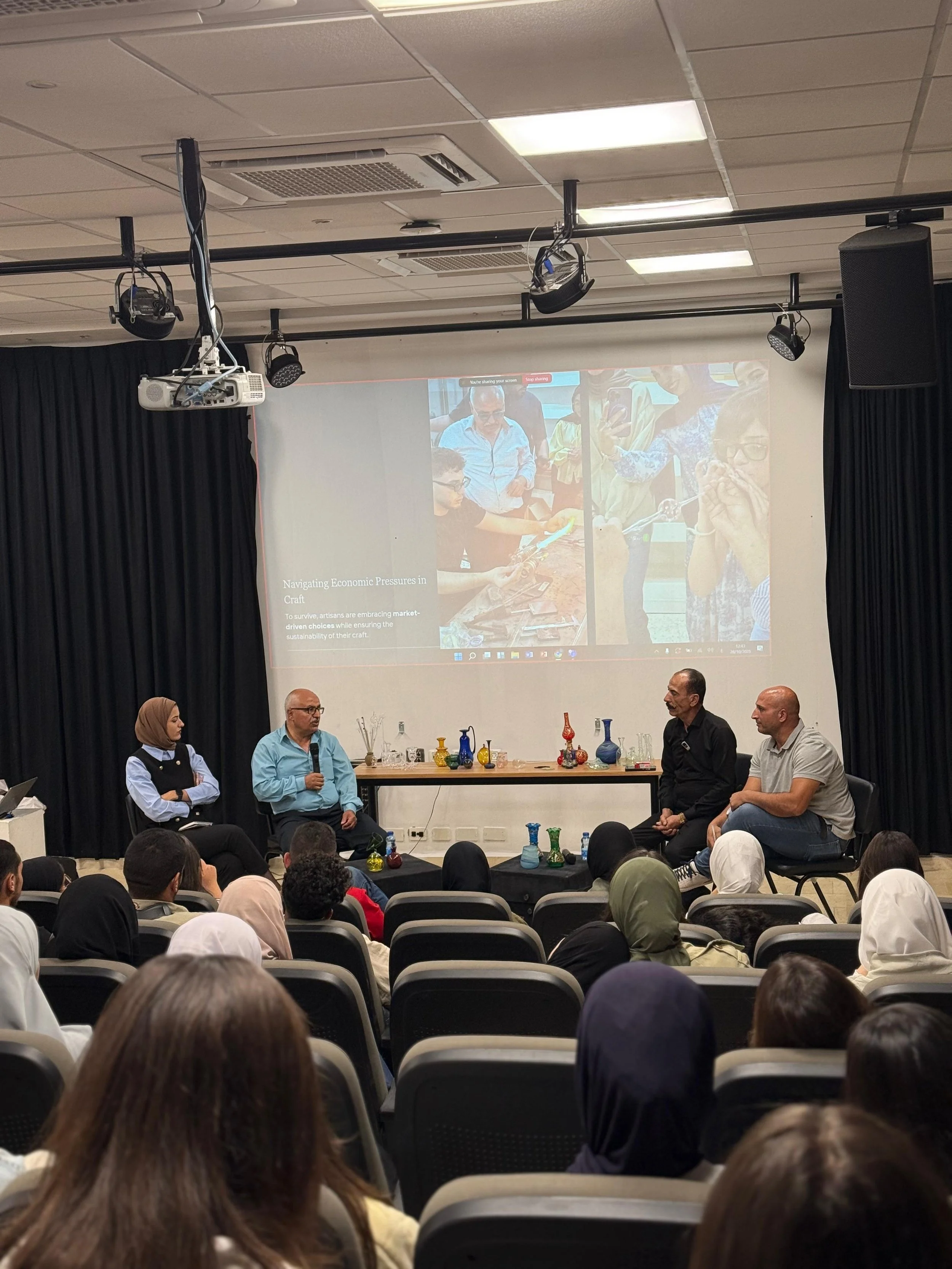
This public talk explored the evolving landscape of Palestinian glassblowing through the experiences of two artisans: Abu Marwan and Abu Wahid. The discussion investigated how tradition, innovation, and survival intersect in today’s craft practices, reflecting how artisans negotiate preserving heritage while adapting to changing markets, technologies, and teaching contexts.
The conversation highlighted the differences between these two approaches, the experience of teaching students, and the challenges and future of glassblowing in Palestine.
Designers x Artisans 03, Pottery, Memory, and Design
Speaker: Mirna Bamieh
Location: Online
This public talk explores the intersection of materiality, craft, design, and storytelling into a cohesive whole through examining the work of artist Mirna Bamieh. Deeply intertwined in Palestinian heritage and craft, pottery emerges as the uniting thread between remembrance, performance, and preservation.
Mirna Bamieh is an artist with a background in Humanities, Visual Arts, and Culinary studies. Her work melds food, pottery, and storytelling to explore the politics of disappearance and memory production through interactive installations and performances. Centered around limitations and crises experienced by Palestinian communities, Mirna’s multidisciplinary work reaches through generations to revitalize and preserve traditional Palestinian food cultures.
The conversation will highlight the application of craft by the designer themselves. It delves into the use of pottery as a medium that manifests as a product, a utensil, an artwork, and a narrative device, acting as an inspiring case study for the maintaining and evolution of these traditional crafts, as well as their integration with other disciplines and materials.
Designers X Artisans 04: Olivewood Carving
Speaker: Amer Haj Hamad
Location: Faculty of Art, Music, and Design, Birzeit University
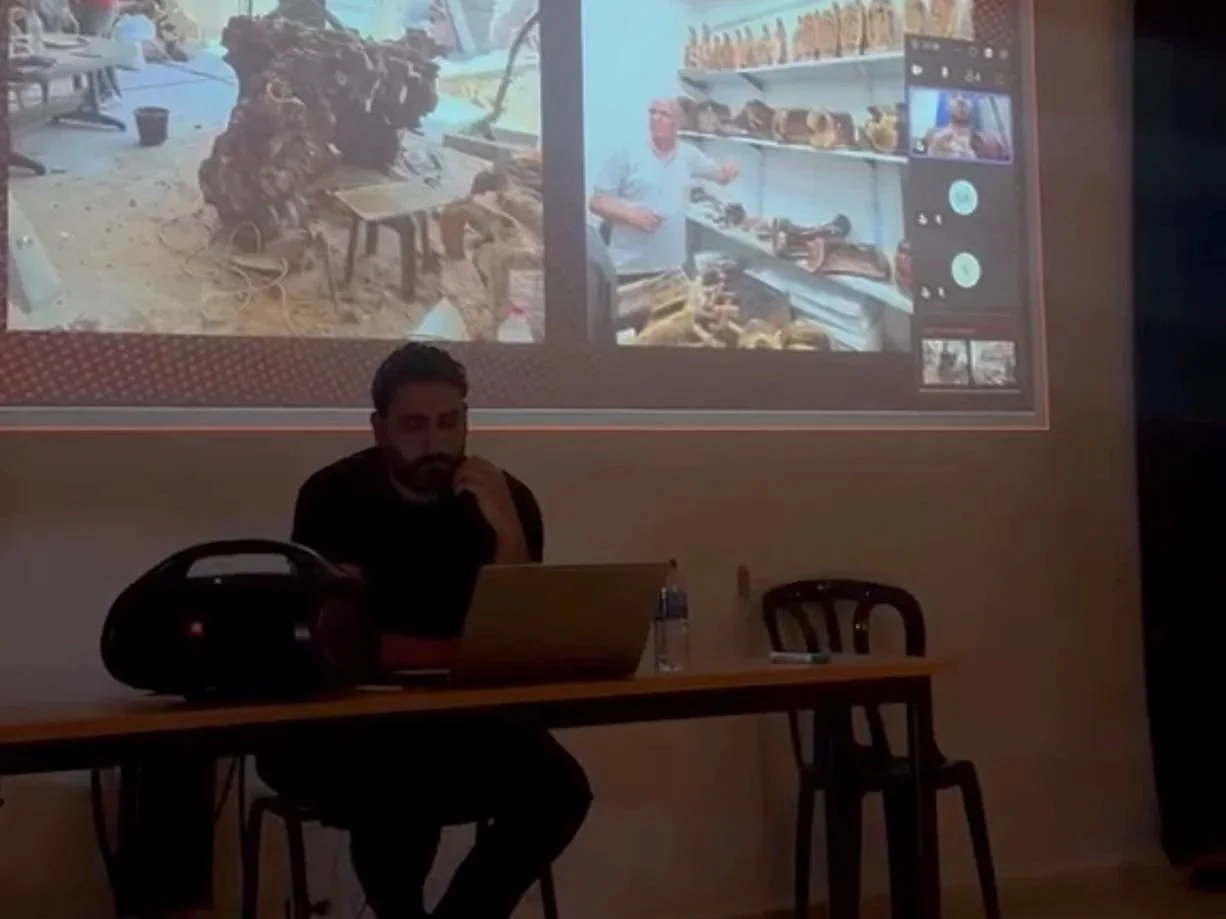
This talk explored the intersection between traditional olive wood craftsmanship and contemporary design through the lens of the designer + maker, where the designer is also the artisan. A central focus of the talk was the shifting role of the designer, not only as a conceptual thinker, but also as an active maker engaged directly with materials and processes. This perspective challenges the separation between design and craft, proposing a more integrated approach where knowledge is developed through making. The talk also addressed how traditional techniques can be reinterpreted and sustained through innovation, without losing their cultural identity. In addition, the talk included a short student presentation reflecting on their summer training experience with Kunuz Foundation, offering insights into direct engagement with artisans and material-based learning.